
Consumer Education
The Complete Guide to Reading Juice Labels in Kenya
Walk into any Kenyan supermarket and you will find an entire aisle of colourful cartons, bottles, and pouches all competing for your attention. Many of them feature images of fresh fruit. Most of them use words like "natural," "pure," or "real." But how many of them are actually fruit juice?
The answer might surprise you. According to the Kenya Bureau of Standards (KEBS), only products containing 100% fruit juice with no added sugar, water, or artificial flavouring may be labelled as "pure fruit juice" under KS EAS 38:2014. Everything else falls into different categories, each with its own rules and composition requirements.
At Jetlak Foods, we have been making beverages in Kenya since 1994. Over three decades, we have watched labelling standards evolve, consumer awareness grow, and unfortunately, misleading packaging persist. This guide is our contribution to closing the knowledge gap. We want you to pick up any juice product in Kenya and know exactly what you are buying.
Why Labels Matter More Than You Think
The World Health Organisation (WHO) reports that excessive sugar consumption is a leading contributor to obesity, type 2 diabetes, and dental decay worldwide. Their 2015 guideline recommends that free sugars make up less than 10% of total daily energy intake, with a conditional recommendation to reduce below 5% for additional health benefits (WHO Guideline: Sugars Intake for Adults and Children, 2015).
In Kenya, the 2015 Kenya STEPwise Survey conducted by the Ministry of Health found that 27% of Kenyans aged 18 to 69 were overweight or obese. Sugar-sweetened beverages are a significant contributor, and many consumers unknowingly purchase products with high added sugar because the packaging looks similar to 100% juice options.
Understanding labels is not about being suspicious of every product on the shelf. It is about making informed choices for yourself and your family.
The Four Categories of Juice Products in Kenya
Kenyan labelling standards, aligned with the East African Standards (EAS) framework, recognise four distinct categories of juice-related beverages.
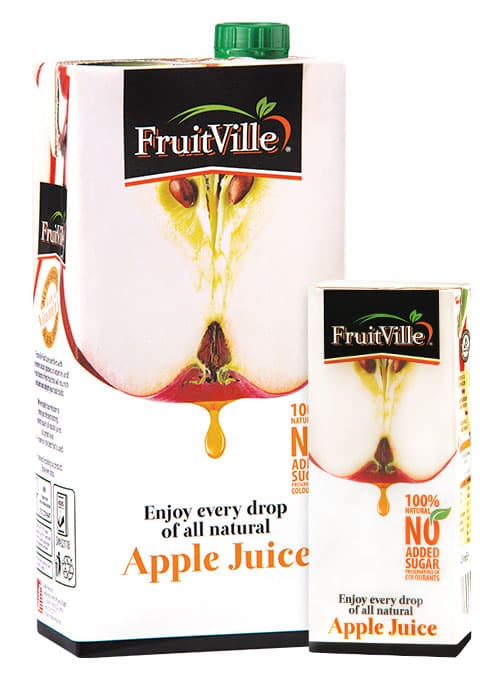
The first category is 100% Fruit Juice. This product contains only juice extracted directly from fruit. No water is added. No sugar is added. The only processing involved is pasteurisation for safety. On the label, you will see "100% fruit juice" or "pure fruit juice." The ingredients list will contain only the fruit name. FruitVille falls into this category. Every carton of FruitVille contains 100% fruit juice with no added sugar, no preservatives, and no artificial flavouring.
The second category is Fruit Juice from Concentrate. This is fruit juice that was concentrated (water removed) for transport, then reconstituted by adding water back to its original strength. The nutritional profile is very close to fresh-squeezed juice. Look for the phrase "made from concentrate" or "reconstituted fruit juice" on the label.
The third category is Fruit Nectar. Nectar contains between 25% and 50% fruit juice, depending on the fruit type, with the remainder being water and often added sugar. Under KS EAS 39:2014, nectars must clearly state the fruit juice percentage on the label.
The fourth category is Fruit Drink. This is the broadest and most common category. Fruit drinks can contain as little as 6% to 10% actual fruit juice. The rest is water, sugar, flavouring, and sometimes colourants. Our Frosti brand sits in this space, and we label it clearly as a fruit drink, not juice.
How to Read the Ingredients List
Kenyan labelling law requires that ingredients be listed in descending order of weight. This means the first ingredient makes up the largest proportion of the product. If water and sugar appear before any fruit ingredient, you are looking at a fruit drink, not juice.
Try this next time you are in the shop: pick up three different brands and compare the first three ingredients. You will quickly see a pattern. Products that lead with "fruit juice" or a specific fruit puree are very different in composition from those that lead with "water, sugar, fruit flavouring."
Also look for the KEBS Diamond Mark of Quality. This certification means the product has been tested and meets the relevant Kenyan standard. As of 2023, KEBS reported that it had certified over 8,000 products across food and beverage categories (KEBS Annual Report 2022/2023).
Understanding Sugar Content
Sugar on a juice label can be confusing because fruit naturally contains sugar (fructose). A glass of 100% orange juice will still show sugar on the nutrition panel, even though none was added.
The key distinction is between naturally occurring sugars and added sugars. Under the updated KS EAS 38:2014 standard, 100% fruit juices cannot contain added sugars. If you see "sugar" or "sucrose" in the ingredients list of a product labelled as pure juice, that product may not comply with the standard.
The WHO recommends that adults consume no more than 50 grams of free sugars per day, with the ideal target being under 25 grams. A single 250ml serving of some fruit drinks sold in Kenya can contain 25 to 30 grams of added sugar. That is your entire recommended daily allowance in one glass.
This is precisely why reading labels matters. A family buying what they believe is juice might actually be purchasing sugar water with a small amount of fruit flavouring.
The "Natural" and "No Preservatives" Claims
These phrases sound reassuring, but they are not always meaningful. In Kenya, the term "natural" is not strictly regulated the way "100% fruit juice" is. A product could be labelled as "natural" while still containing added sugar, water, and concentrates.
"No preservatives" is a more meaningful claim, but it depends on the preservation method. Pasteurisation (heating the product to kill bacteria) is a preservation method that does not require chemical preservatives. All FruitVille products are pasteurised without added preservatives. However, some products that claim "no preservatives" may use other additives like citric acid or ascorbic acid for shelf stability.
The most reliable way to evaluate any product is to read the full ingredients list and ignore the marketing claims on the front of the pack.
What the Nutrition Panel Tells You
Every packaged food product sold in Kenya must carry a nutrition information panel under KS 2455:2019. This panel shows the amount of energy (kilojoules or kilocalories), protein, total fat, carbohydrates, and sugar per serving and per 100ml.
When comparing two juice products, look at the sugar content per 100ml. A 100% fruit juice typically contains between 8 and 12 grams of naturally occurring sugar per 100ml. Fruit drinks can contain 10 to 14 grams per 100ml, much of it added. The difference may seem small per serving, but it adds up across a day, a week, and a year.
Also check the serving size. Some brands use a 200ml serving size while others use 250ml. Comparing sugar content per 100ml normalises the numbers and gives you an accurate comparison.
A Note on Imported Products
Kenya imports a significant volume of juice products, particularly from South Africa, the UAE, and Europe. Imported products must still comply with KEBS standards and carry proper labelling in English or Kiswahili. However, the Kenya National Bureau of Statistics reported that Kenya imported KES 4.2 billion worth of fruit juices and beverages in 2022, and labelling compliance varies.
If you purchase an imported product, apply the same checklist. Look for the fruit juice percentage. Read the ingredients list. Check for the KEBS mark. If any of these are missing, consider choosing a locally manufactured alternative where standards enforcement is more consistent.
How FruitVille Measures Up
We created FruitVille because we believed Kenyan families deserve a juice that is genuinely juice. Every FruitVille product is 100% fruit juice. The ingredients list contains fruit juice and nothing else. No added sugar. No water. No concentrates. No artificial colours or flavours.
Our production facility in Ruiru processes fruit using aseptic technology, which preserves taste and nutritional value without the need for chemical preservatives. Every batch is tested in our in-house laboratory and independently verified to meet KEBS standards.
We are not claiming to be the only good product on the shelf. We are saying that you deserve to know the difference, and we are committed to making that difference easy to spot.
Your Five-Point Label Checklist
Before your next shopping trip, use this simple checklist for any juice product.
First, check the category. Is it labelled as 100% fruit juice, juice from concentrate, nectar, or fruit drink? This tells you the approximate fruit content immediately.
Second, read the first three ingredients. If water and sugar come before fruit, the product is mostly water and sugar.
Third, compare sugar per 100ml. Use the nutrition panel to compare across brands on a level playing field.
Fourth, look for the KEBS Diamond Mark. This confirms the product has met Kenyan quality standards.
Fifth, ignore front-of-pack marketing. Phrases like "natural," "real fruit," and "wholesome" are not regulated in the same way as the ingredients list and nutrition panel.
Teaching Children to Read Labels
One of the most valuable things you can do as a parent is involve your children in grocery shopping and teach them to read labels. It builds awareness early and creates habits that last a lifetime.
Start simply. Ask your child to find the word "sugar" on the back of a product. Compare two products together. Make it a game. Children who understand food labels grow into adults who make healthier choices, and that benefits the whole family.
At Jetlak Foods, we serve families. We have been doing so for over 30 years. We believe that transparency is not just a regulatory requirement. It is a sign of respect for the people who trust us with their health and their children's health. The next time you reach for a juice product, turn it around. Read the back. You now have everything you need to choose wisely.